Collecting Stars on Stamps — Astronomy for the beclouded astronomer (Page 1)
A Long Time Ago in a Galaxy Far Away….
A long time ago in a galaxy far away…. Actually, it wasn’t a very long time ago, or in a galaxy far away. It happened just 40 years ago (a fraction of a blink in galactic time), right here on Earth, in and around Prince George, British Columbia, 800 km north of Vancouver, and, by the way, in the Milky Way galaxy. The protagonists were my son, Paul, me, a really cool telescope, and the Universe.
I am an enthusiastic amateur astronomer because Paul had become an even-more-enthusiastic amateur astronomer. In his early teens, in the mid 1980s, Paul revealed the inquisitiveness, patience, and intelligence of a professional astronomer. When his mom and I were inside on wintry nights watching The Beachcombers or Street Legal, Paul would be outside, using 8 X 40 binoculars and star charts to locate deep-sky objects that my older eyes could barely resolve, if at all. His bedtime reading, instead of sci-fi or fantasy novels, might well have been Burnham's Celestial Handbook: An Observer's Guide to the Universe Beyond the Solar System.
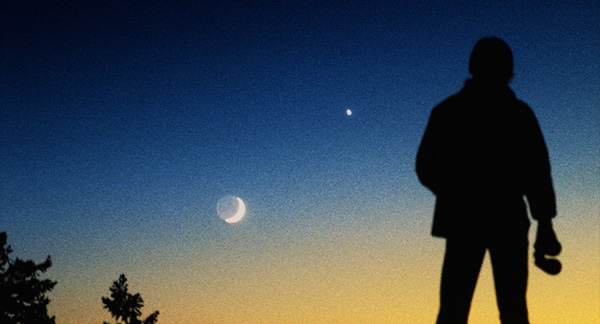
Astronomy always interested me, but my main hobbies were photography and philately. Soon after Paul started spending more time outside with his binoculars than inside watching TV, I decided to try my hand at photographing the night sky.
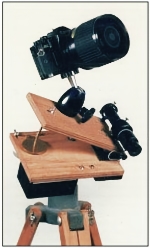
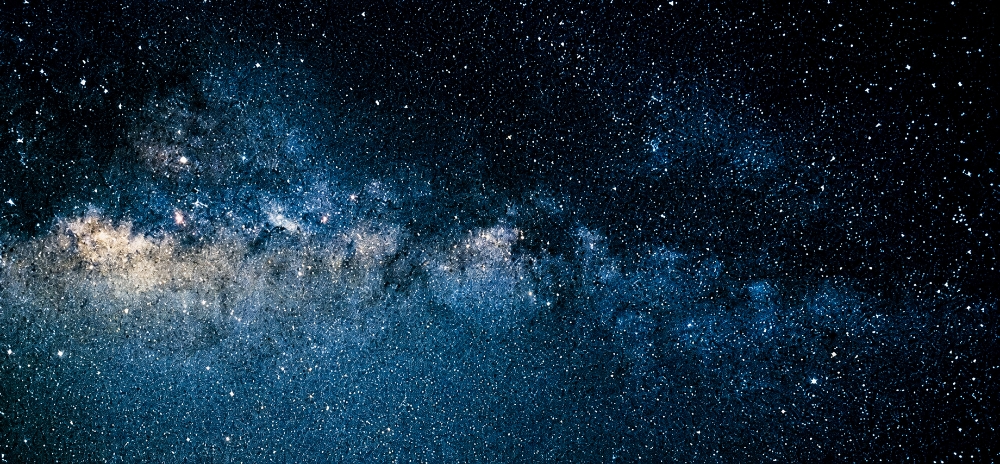
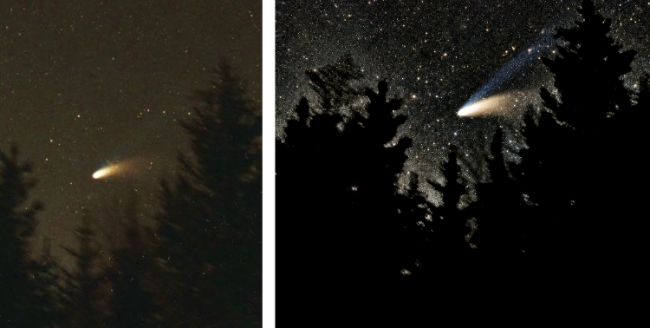
In pre-digital days, I couldn’t afford the telescopes that accomplished astrophotographers used, so I went cheap: I followed instructions in Astronomy magazine to build a manually operated “barn-door” star tracker. My tracker, mounted on a camera tripod and supporting my Nikon F-801 SLR loaded with Kodak Ektachrome transparency film, was not the last word in astrophotography. While it allowed the camera to more or less match the rotation of the earth, allowing exposures of at least a minute, it was subject to vibration which produced images of stars that were more often wiggly streaks instead of points of light. The only lens that worked reasonably well was my 28mm lens, which because of its wide field of view reduced the apparent size of stars in the image as well as obvious camera shake. But I don’t consider that I wasted my time with the star tracker. Without it, I would not have been able to take the following photo:
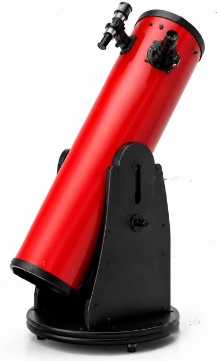
Paul’s universe expanded yet more when we bought a high-quality, eight-inch Dobsonian telescope — a “Dobbie” — with an eight-inch primary mirror and three high-quality eyepieces of different focal lengths. On many a night, spring and summer, fall and winter, we drove to the darkest skies we could find, usually several miles north of Prince George to escape its light pollution.
Dobsonian telescopes were popularized by the amateur astronomer John Dobson in the 1960s. Dobsonians are basically Newtonian telescopes, invented by the British scientist Sir Isaac Newton in 1668, and utilizing a concave primary mirror and a flat diagonal secondary mirror that reflects light into the telescope’s eyepiece.
Dobsonians — often called “light buckets” — are optimized to reveal faint deep-sky objects such as galaxies and nebulae. Dobbies are inexpensive, dead-easy to use, relatively easy to transport (depending on the size of the primary mirror!), and popular in the amateur telescope-making community, where the design was pioneered and continues to evolve.
Not an astronomer’s night dream
Because of its high latitude (nearly 54°N), Prince George is not an astronomer’s dream. In high summer the sky never gets truly dark: for several weeks around the solstice the Sun never sinks far enough below the horizon to end twilight, so faint deep-sky objects like nebulae and galaxies stay washed out even at midnight. If you’re lucky, massed squadrons of mosquitoes will respect your mosquito repellent. We weren’t often that lucky.
In fall and winter we could start observing much earlier in the evening, but the irritation of mosquitoes gave way to real danger: temperatures well below freezing. More than once I came home unsure whether my toes would need amputating. One sub-freezing night in the countryside miles northwest of Prince George, while Paul’s telescope transported us deep into the Universe, the classical music we’d been listening to on the car stereo faded to silence. The car’s battery had died. Cellphones were still 20 years in the future, so we had to walk a quarter mile to a nearby darkened house where we pounded on the door and shouted ourselves hoarse until we woke the owner, then used his phone to call Paul's mom, who drove out to us in her car, rather grumpily, so we could jump-start my car. We arrived home only half dead from hypothermia.
In midwinter at Prince George’s latitude, darkness lasts about thirteen hours — plenty of time for even a well-insulated astronomer to suffer from frostbite, or simply suffer. Even on clear nights, high-altitude turbulence makes stars and planets dance and shimmy, and at any time of year aurora borealis can wash stars from the sky — often not as a light show but as a dull whitish glow smothering whole swaths of the northern heavens.
Despite the less-than-optimal nights, Paul and I regularly left Earth in our imaginations, diving deep into space beyond the solar system and the Milky Way. As night people, we saw the world as day people rarely do. Like our earliest ancestors, we watched constellations rise and set like celestial clockwork; like Galileo, we watched Jupiter's moons vanish behind the planet and reappear one by one. In the spring of 1997, we were rewarded with the appearance of the spectacular twin-tailed comet Hale-Bopp.
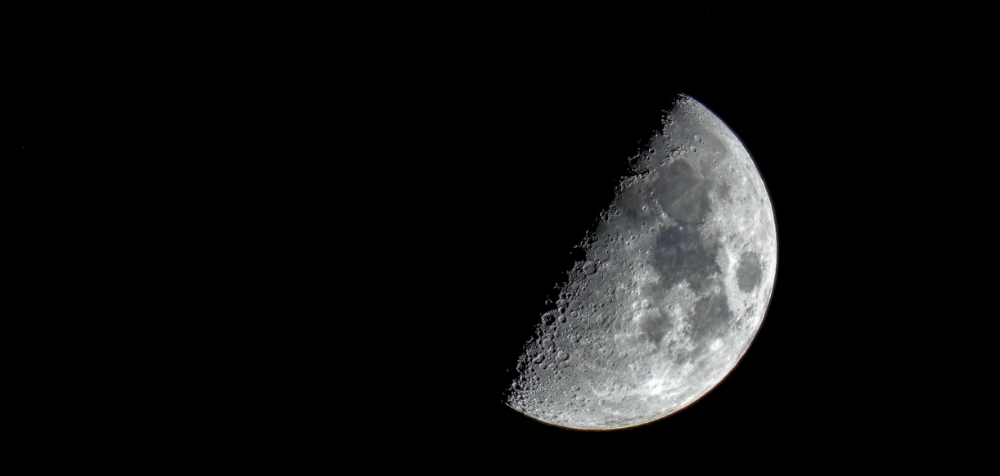
Paul’s greatest passion was deep space astronomy. He revelled in finding wispy nebulae and globular clusters — “globbies” — light years from earth. But he ignored the Moon, despite my own passion for that not-so-distant world. After all, the first lunar landing had occurred on his parents’ watch, so to speak. Paul’s mom and I stayed up all night to watch Neil Armstrong take his “…one small step for [a] man, one giant leap for mankind,” three years before Paul landed on Earth. Today, Paul, in middle age, has found new faith in the Moon, and has bought a new camera to take some superb photographs of it:
Throughout Prince George's autumn and winter, stratus and nimbostratus clouds often stretch from horizon to horizon and last for days, even weeks. Then when skies clear, temperatures can plunge to -40°C for days at a time. You do not want to spend more than a few minutes outdoors at those temperatures, especially with a telescope, because just breathing near the eyepiece will cause it to frost over. Besides, you may have trouble seeing anything, much less distant stars and nebulae, because your eyelids are constantly freezing shut!
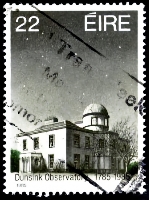
One cloudy, icy night in the early 1990s, when Paul had gone off to university, while I was working with my Ireland stamp collection instead of even thinking about going outside in the dark to point my camera skyward, I came across a stamp, pictured at left and issued in 1985, commemorating the bicentenary of Dunsink Observatory in Dublin. I had never heard of that observatory, but the stamp reminded me of one or two other stamps picturing observatories and I wondered what other astronomical subjects might be pictured on stamps. My Scott Standard Postage Stamp Catalogue confirmed the existence of hundreds, at least, and I began collecting them in earnest. There turned out to be thousands.