Collecting Stars on Stamps — Astronomy for the beclouded astronomer (Page 2)
I Discover Stars on Stamps
Four decades ago, I learned that stars, constellations, galaxies, comets, asteroids, the solar system, the sun, solar eclipses, planets and their moons, Earth’s Moon, lunar eclipses, aurora, astronomers, observatories, telescopes and what I call “astromythology” have been featured or soon will be featured on many postage stamps issued by countries around the world.
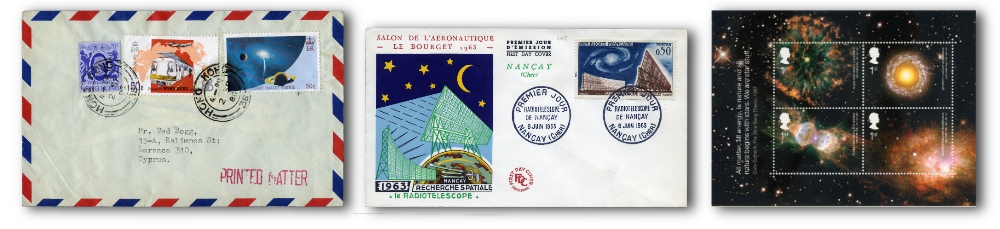
So far I have collected several hundred astronomy-related stamps and a couple of dozen picture postcards, covers, first-day covers or FDCs, and souvenir sheets. People who haven’t been infected with the philatelic bug know what picture postcards are, but the other terms may need a little explanation. See the sidebar at the right.
Below are examples of a cover, a first-day cover, and a souvenir sheet:
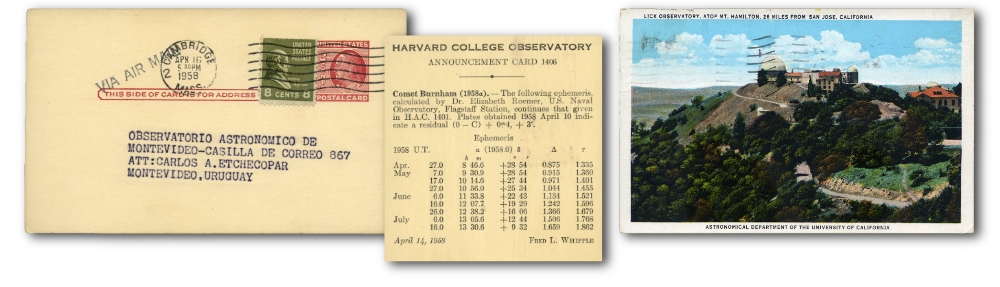
Two other types of philatelic collectibles appear in my Stars on Stamps collection — postcards and postal cards, and yes, there is a difference. Postcards are commercially produced cards for sending a message by post without an envelope, typically having a photograph or other illustration on one side. Postal cards are part of the class of officially produced postal stationery that includes imprinted stamps signifying the prepayment of postage but do not typically feature illustrations. Below are examples of a postal stationery card and an astronomy-related picture postcard:
My Stars on Stamps collection could contain several thousand stamps and other philatelic collectibles, but my collecting policies and my allowance restrict me to buying items that appeal to me. Most of my collection consists of stamps.
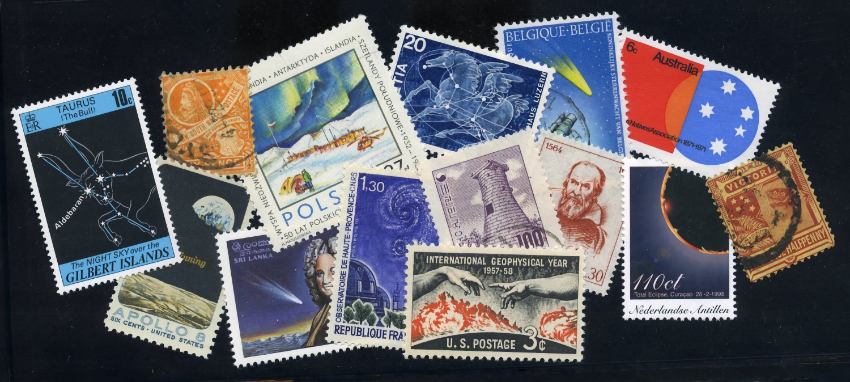
Observatories on stamps
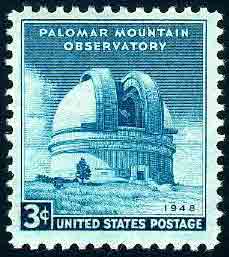
In August 1948, the U.S. Post Office Department issued a stamp commemorating Palomar Observatory, among the best-known observatories in the world. It’s not the iconic dome that makes Palomar important, but the 200-inch Hale Telescope inside it, the world’s largest telescope for 27 years. Overshadowed today by newer giants on the ground and in space, the Hale telescope, fitted with modern digital instruments, is still charting new frontiers in the Universe.
The first stamp to feature an astronomical subject
The first country to issue a stamp featuring an astronomical subject was Brazil. Its definitive issue of 1887 featured the constellation Crux Australis or the Southern Cross, often referred to simply as Crux. It’s no surprise that a devoutly Roman Catholic country like Brazil would choose to represent the Christian cross on a stamp. It is surprising that its representation of Crux is scientifically accurate: it includes the constellation’s “fifth” star, Epsilon Crucis.
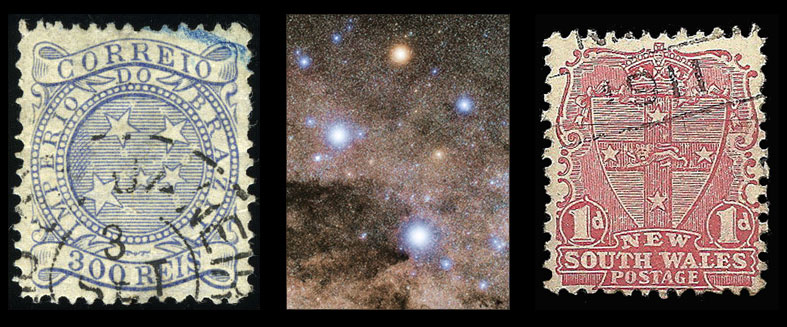
Epsilon Crucis, called Intrometida in Portuguese (translated in English as “Intrusive”) is a fourth magnitude1 orange giant about 228 light-years from Earth. Along with the four stars that give the Southern Cross its shape, Epsilon Crucis is easily visible from the southern hemisphere at practically any time of year; from tropical latitudes of the northern hemisphere, it appears near the horizon for a few hours every night during the northern winter and spring.
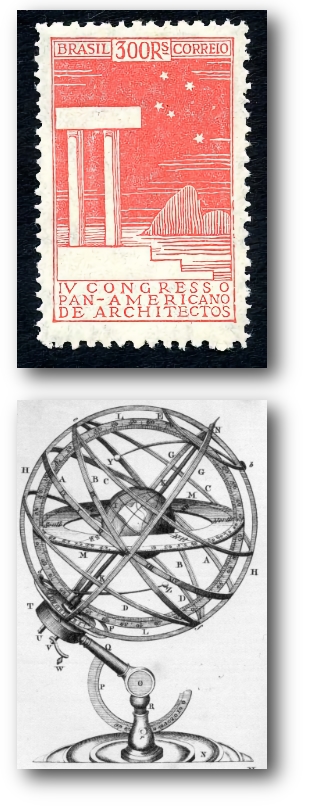
I have about 25 stamps featuring the Southern Cross as the primary design element, and more than half of them show Epsilon Crucis to the right of the cross rather than the left, like the Brazilian stamp, but the Brazilian stamp is not in error.
The design is based on the armillary sphere, an ancient navigational instrument credited to the Greek astronomer Eratosthenes (276–194 BCE). The name comes from the Latin armilla ("bracelet"), reflecting its construction of graduated metal circles representing the equator, ecliptic, meridians, and parallels, with a ball at the centre standing for the Earth (or later, the Sun). Before the telescope arrived in the 17th century, it was astronomers' primary tool for tracking celestial positions. Like a solid celestial globe, an armillary sphere shows the sky as if viewed from outside — reversed from our earthbound perspective.
Curiously, the armillary sphere has an ancient, metaphysical analogue in the beliefs of the Greek philosopher Aristotle, who lived in the 4th century BCE. Aristotle was among the most influential philosophers of the ancient world. Among his best-known and most enduring beliefs was that the heavens were changeless, while everything “below the Moon” was in constant flux: Storms, tides, seasons, earthquakes, volcanic eruptions, and life and death itself proved his point. But how about “above the Moon”? How did Aristotle explain what he and everyone else could see in a clear, night sky?
Aristotle believed that the Earth sat motionless at the centre of a finite universe, surrounded by some 55 invisible, nested spheres that carried the Moon, the Sun, the planets, and the stars around it. Any changes that seemed to occur were explained by the changing relationships between the spheres themselves or between people on the Earth and the spheres. For nearly 2,000 years, because most rational people irrationally accepted Aristotle’s beliefs, they fell into the trap of believing that what they saw in the night sky was what their ancient ancestors had seen and what their remote descendants would see. The Southern Cross constellation is a good case in point.

Aristotle was wrong — the stars move!
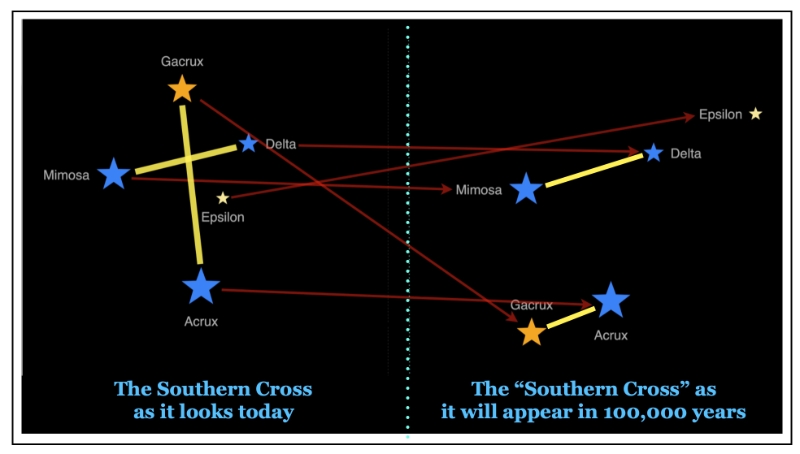
Because the Earth's axis slowly wobbles, a motion called precession, the whole sky shifts over the centuries. In ancient times the Southern Cross rose above the Mediterranean horizon, and Ptolemy catalogued its stars from Alexandria. Precession then hid it from European eyes until navigators rediscovered it in the 1500s. But precession is a purely earthbound process that has no effect whatsoever on anything else in the Universe. What those 16th-century navigators didn’t know, and no one else knew either, was that every star in the night sky is subject to a process that astronomers call “proper motion,” is constantly on the move in its own direction and velocity, and is thus changing its relationship to every other star. Human lifetimes are way too short to notice, but stars — all stars — are moving and always have been moving unimaginably great distances at unimaginable velocities.
Think of what that might once have meant to people looking in wonder at the night sky.
If you had lived on the south coast of modern-day South Africa 100,000 years ago, you would have been one of the earliest members of our own species, Homo sapiens, no less intelligent and curious than we are; Blombos Cave, on that same coast, holds some of humanity’s earliest known artwork. Gazing at the night sky, you would have seen the five stars that now make up the Southern Cross, but you would have paid little attention to them, because they would have looked nothing like a cross — and the cross wouldn’t become a common symbol of Christianity until the 4th century CE.
Over the next 100,000 years, proper motion would slowly move the stars that now make up the Southern Cross into the positions that we currently see. In the far distant future, proper motion will have slowly moved, sheared, bent, stretched and distorted the Southern Cross so much that it will no longer exist as a cross or any particular shape.
-
In astronomy, magnitude refers to the brightness of a star or other object in relation to other stars or objects. It seems counter-intuitive, but a high-magnitude star is dimmer than a low-magnitude star. Thus, the sun has an apparent magnitude of −27, while Pluto, once considered a planet but now classified as a dwarf planet, is so dim — apparent magnitude of 14 — that it can only be seen with large telescopes. ↩︎