Collecting Stars on Stamps — Astronomy for the beclouded astronomer (Page 3)
Tycho Brahe, who had a metal nose, challenged Aristotelian astronomy
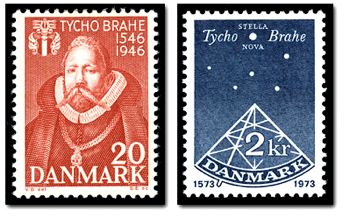
Two Danish stamps in my collection, pictured at the left, commemorate the 16th Century Danish astronomer, Tycho Brahe. Working without a telescope (which hadn’t been invented), Brahe made a significant observation that contradicted Aristotle’s theory of the immutability of the heavens.
I learned about Brahe’s 1572 observation1 of a supernova which unexpectedly appeared in the constellation Cassiopeia; the supernova, an explosion of a star, is shown as a white star at the top of the stamp. Brahe himself is shown on the other stamp, displaying his metal nose.2
The next year, in 1573, Brahe published De nova stella (On the new star), arguing that since the Stella Nova, unlike the planets, did not move against the background of other stars, it could not be a planet. And, since it was in a location that had previously been assumed to be empty space, Brahe challenged the Aristotelian belief in the inalterable perfection of the “supralunary sphere” (everything beyond the orbit of the moon). Curiously, Brahe never abandoned the other pillar of ancient astronomy, a motionless Earth at the centre of the universe: in his own system the planets circled the Sun, while the Sun circled the Earth. Brahe criticized those who dismissed his observations, writing in the preface to De nova stella, “O crassa ingenia. O caecos coeli spectatores" ("Oh thick wits. Oh blind watchers of the sky").
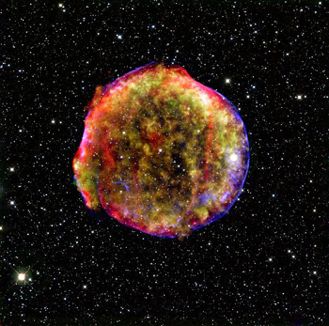
Brahe’s Nova stella is still with us, and still where it was in 1572, in the constellation Cassiopeia. It exists as a still-expanding globe of gas and high-energy particles and enjoys three astronomical designations: SN 1572 (Supernova 1572), B Cas (Cassiopeia B), or 3C 10 (Third Cambridge Catalogue of Radio Sources 10). It’s invisible in wavelengths that we humans evolved with, but x-ray images reveal its structure, as shown in the image at the left.
Galactic distances
Brahe was correct in his belief that the Universe was indeed alterable, but even he could not have comprehended the power of a supernova: astronomers believe that a supernova as close to earth as 26 light years would destroy our ozone layer and result in another mass extinction event, like that of the dinosaurs, except that the extinction would include us. A star that is 26 light years from earth is very close in galactic terms. Astronomers estimate the diameter of the observable universe to be about 93 billion light-years. Or, to put it another way…
Space is big. Really big. You just won’t believe how vastly, hugely, mind-bogglingly big it is. I mean, you may think it’s a long way down the road to the chemist’s, but that’s just peanuts to space. — The Hitchhiker’s Guide to the Galaxy, by Douglas Adams
Only in the 1960s, scientists working with telescopes at Palomar Mountain discovered the remnants of Brahe’s supernova. The supernova has since been confirmed as a Type Ia, in which a white dwarf star accretes matter from a companion until it reaches the Chandrasekhar Limit and explodes. A shell of gas is still expanding from its centre at about 9,000 km/s.
Lessons from Stars on Stamps
There’s little point in collecting stamps or anything else unless your collection can teach you something. My Stars on Stamps collection has taught me a good deal about the history of astronomy. One stamp in particular, issued by Norfolk Island in 1969, sent me to Google and to my library.
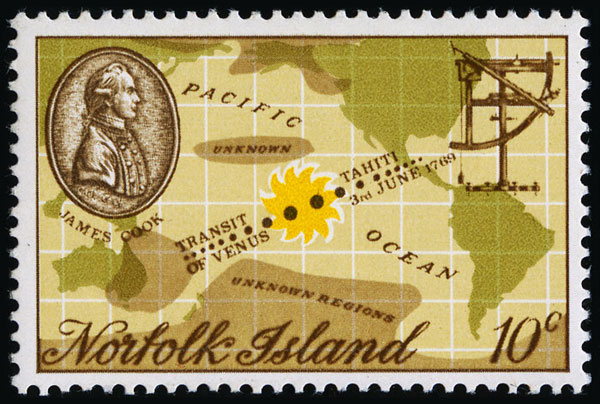
The primary purpose of Captain James Cook’s first expedition to the Pacific was to observe the transit of Venus across the face of the sun on June 3, 1769. Timing the transit from widely separated places on Earth would allow astronomers to calculate the distance from the Earth to the Sun — the key to measuring the scale of the whole Solar System.
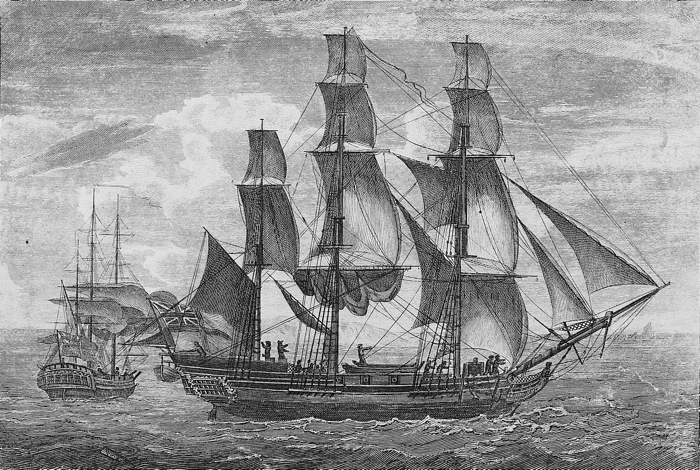
My library contains a tattered copy of A Narrative of the Voyages Around the World, Performed by Captain Cook. With an Account of His Life During the Previous and Intervening Periods, by Rev. Alfred Kippis, a Fellow of the Royal Society, first published in 1788. In his brief account of the Transit of Venus, Kippis writes that Cook and the scientists in the expedition observed a “dusky cloud” around Venus, which made it difficult to establish the times of contact. They were pleased with their success, but their pleasure was premature….
Back in England, the expedition’s results were judged disappointing, and much of the blame fell on the expedition’s astronomer, Charles Green, who couldn’t very well defend himself because, well, he had died during the return voyage to England! Later analysis, however, has shown that the expedition’s observations were as good as any made at the time, and that the difficulties resulted not from poor science but from the “black drop effect,” an optical illusion that blurs the moment Venus touches the edge of the Sun, and which dogged observers of the transit around the world.
Kippis’s account provides a glimpse of the harsh naval discipline in the Royal Navy of the 1700s: While the officers and scientists were observing the Transit of Venus, sailors stole “spike-nails” to trade to the natives, more specifically to native women in return for sexual favours. One thief received two dozen lashes, a vicious punishment which could disable a man for days.
The first astrophotos on stamps
Another first in Stars on Stamps is Mexico’s 1942 Astrophysics Congress issue, which featured — for the first time — photographs of astronomical subjects, i.e., astrophotos.
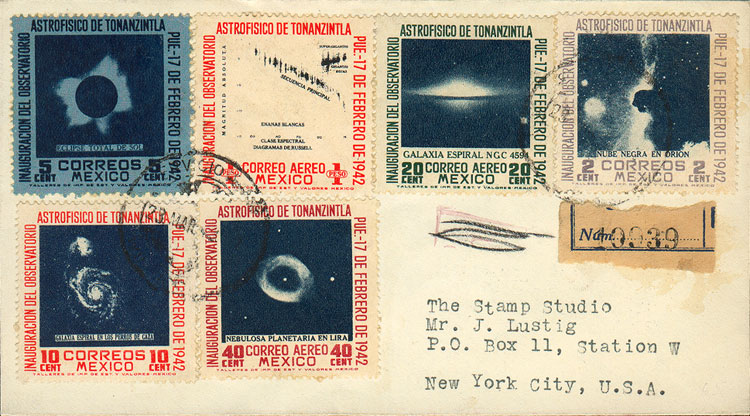
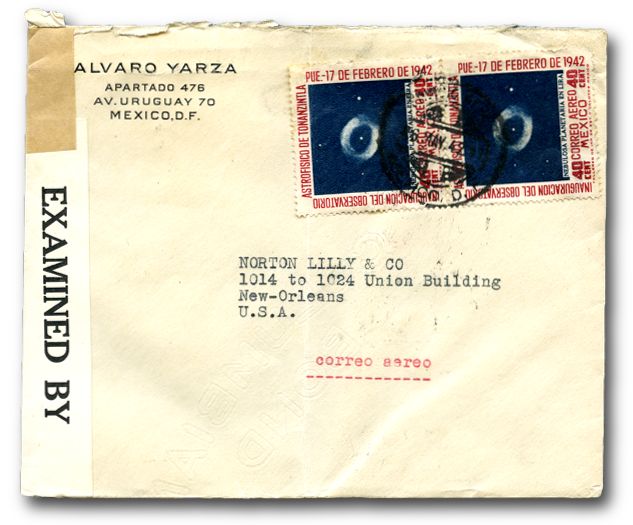
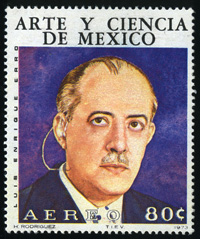
The observatory at Tonantzintla holds a unique place in the history of astronomy and astrophysics: its construction resulted from a collaborative, international effort of astronomers and astrophysicists at a time — during the Second World War — when pure science was being sidelined by the development of new military technology. The internationally famous astronomer Harlow Shapley worked with his friend, Mexican diplomat and amateur astronomer Luis Erro, to ensure that at least some technological development was directed toward scientific rather than military pursuits. Read more about the Tonantzintla stamps and observatory on my VANPEX 2012 one-sheet philatelic exhibit.
Halley’s Comet
Many stamps were issued in the mid-1980s to celebrate one of the most notable of recurrent astronomical events in earth’s history, the periodic return, every 75 or 76 years, of Halley’s Comet.
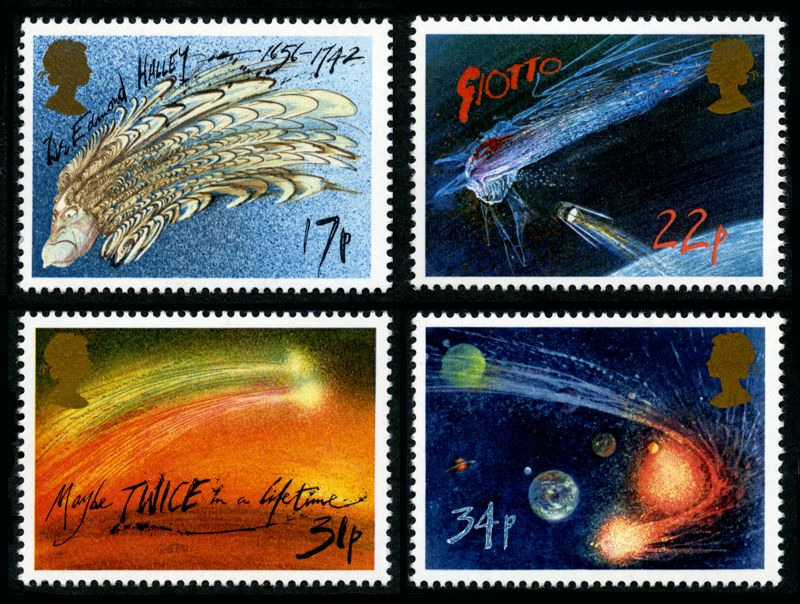
Halley’s Comet is the only short-period comet that is clearly visible to the naked eye from Earth, and the only naked-eye comet that could appear twice in a human lifetime, assuming a human lifespan of 75 or 76 years. Halley’s Comet’s next appearance will be in mid-2061.
Halley's returns to the inner Solar System have been observed and recorded by astronomers since at least 240 BCE. Its long-heralded 1986 appearance, however, was a bust. The comet’s tail, celebrated and feared in former times, was scarcely visible. Later 20th Century comets, notably Hale-Bopp, were far more spectacular.
The Hubble Space Telescope opens earthbound eyes
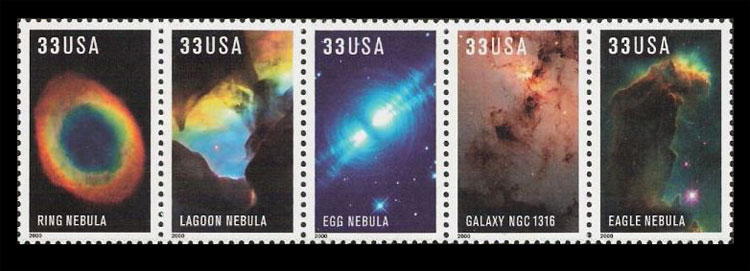
With the revolution in digital imaging and the launching of satellites and space probes, astronomers have taken giant leaps in their understanding of the Universe. Images obtained by the Hubble Space Telescope, launched in 1990, have opened earthbound eyes to sights that we never suspected. The U.S. Hubble Telescope issue of 2000 celebrates some of those incredible images:
Constellations
Among the most attractive of astronomy topical stamps are those illustrating the constellations, those bright stars that seem to earthbound cultures to represent particular shapes, often representative of mythological beings.
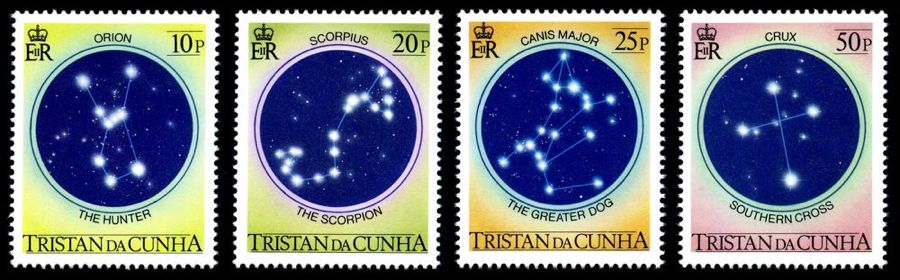
Constellations that we on earth easily recognize, such as the Big Dipper, don’t actually exist in nature. All stars are at such a great distance from earth that we see them as if they are on a plane at right angles to our line of sight, but in reality the individual stars of a given constellation are at varying distances from earth. Someone on a distant planet might see the same stars, but from such a different perspective that they would form a very different shape, or no particular shape at all.
I no longer live in Prince George, but in Vancouver, where clouds and smog often prevent visual astronomy. Even on clear nights, serious light pollution obscures all but the brightest objects in the sky. But my Stars on Stamps collection still allows me to continue my voyage of discovery through the Universe.
-
Tycho Brahe did not necessarily discover his Nova stella, which was independently observed by many individuals. It was one of some eight supernovae visible to the naked eye and recorded in that period. ↩︎
-
While studying at the University of Rostock in Germany in 1566, Tycho Brahe lost part of his nose in a nighttime sword duel against fellow Danish nobleman and third cousin, Manderup Parsberg. They had quarrelled over the legitimacy of a mathematical formula, and since neither had the resources to prove the other wrong, they ended up resolving the issue with a duel, which resulted in Tycho losing the bridge of his nose and developing a life-long interest in medicine and alchemy. It isn’t known who “won” the duel, but the cousins made up. Brahe, however, is said to have worn a prosthesis for the rest of his life. In 2010 his body was exhumed; an examination of facial bones showed that the prosthesis he was buried with was made of bronze, but he likely had multiple nasal prostheses to choose from in life! (Prostheses were worn with pride by wealthy amputees in Brahe’s time.) ↩︎